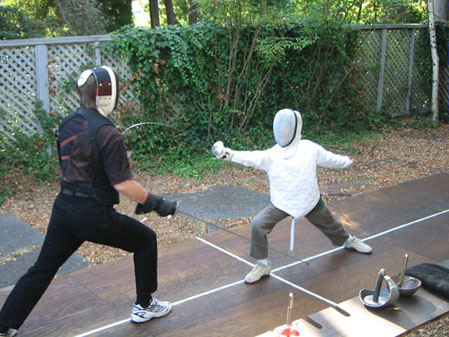
How Old Should A Child Be Before Learning To Fence?
For children, fencing demands a lot, presenting many of the same challenges as those posed by piano lessons. Students must be able to concentrate for half an hour and be willing to indulge in seemingly endless repetition. Added to this, they must be physically coordinated, have good balance and possess a sense of timing and depth perception. It is important to appreciate that while fencing may cultivate these attributes, it doesn't create them. On average, children are ready to benefit from fencing lessons by the age of eleven years. Some are able to meet these challenges at an earlier age, especially if they are motivated.
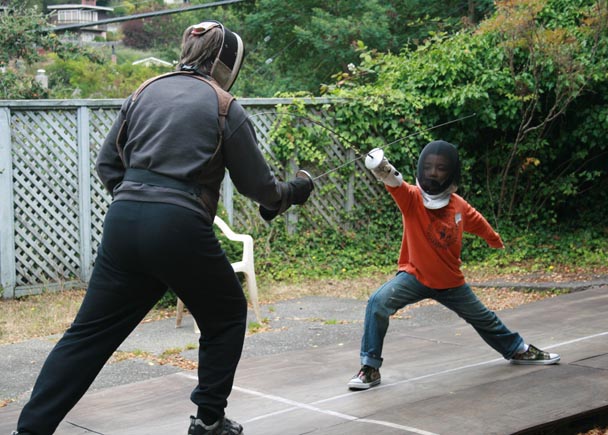
Young Chadson, age 9, executing a straight thrust.
In deciding whether their children are physically and mentally ready to deal with the challenges of learning to fence, parents should know that there are some fencing teachers who will take pupils at any age, put weapons in their hands and turn them loose to flail aimlessly about without rhyme or reason. What they present as a fencing "program" is little more than day care with a fencing theme. Teachers like these are the modern-day counterparts to fencing masters of dubious repute who, in centuries past, were willing, for a sufficiently large sum of money, to reveal to trusting, gullible students their "secret thrusts."
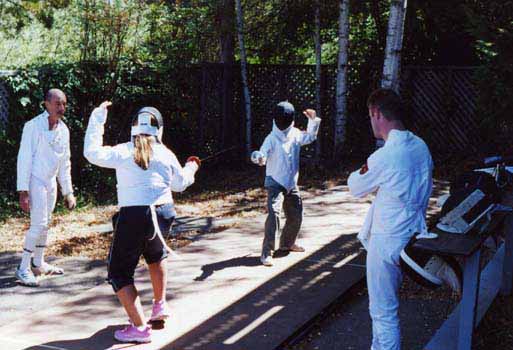
Thirteen year-olds Aaron Todd and Claire Martin cross blades at
La Spada Nemica's annual barbeque in Mill Valley.